Why Pump Selection Starts with the Process — Not the Pump
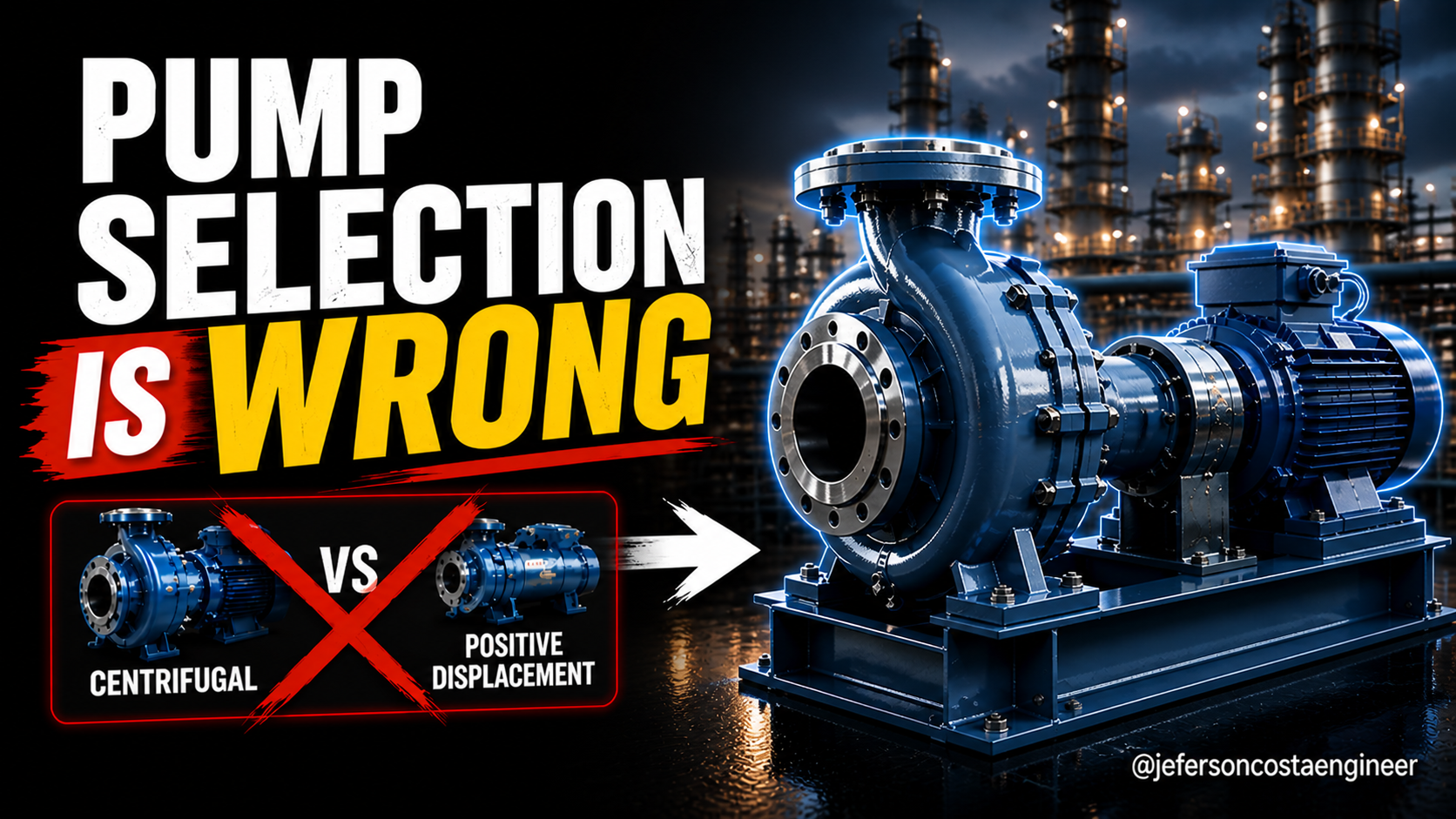
Many engineers believe that selecting a pump is simply a matter of choosing between centrifugal and positive displacement based on flow rate and pressure. In real plant design projects, however, this approach is incomplete — and it can lead to costly mistakes downstream.
Having worked extensively on pump datasheets and vendor quotation reviews, I want to share a perspective that will change how you approach pump selection in your projects.
Start with the Process, Not the Equipment
As a chemical process engineer, your starting point is never the pump. It is the process.
Before any equipment selection begins, you must fully understand:
- Fluid properties — density, viscosity, and vapor pressure across the full operating range
- Operating conditions — required flow rate, pressure, and temperature
- System characteristics — static head, friction losses, and other system resistances
This process basis is what drives the pump selection. Without it, any choice you make is essentially a guess.
Understanding the Main Pump Types
The pump coverage chart from Perry’s Chemical Engineering Handbook illustrates how different pump types serve different operating windows. Here is a practical breakdown:
Centrifugal Pumps
Centrifugal pumps are the most widely used in process plants. They are ideal for high flow rates and low-to-moderate viscosity fluids. Their continuous flow delivery, simple construction, and low capital cost make them a natural first choice for most applications. However, they are not suitable for viscosities above approximately 10 cSt and their flow varies with system resistance — something to keep in mind for control strategy.
Reciprocating (Positive Displacement) Pumps
Reciprocating pumps deliver a nearly constant flow regardless of discharge pressure, making them ideal for high-head, low-flow applications such as metering and high-pressure injection. They handle high viscosity fluids well and achieve the highest efficiency among pump types. The trade-offs include periodic flow delivery (pulsation), the need for relief valves, and higher capital and maintenance costs.
Rotary Pumps
Rotary pumps — including screw, gear, and regenerative types — occupy a middle ground. They provide stable, high flow at moderate viscosities and are particularly suited for lubricating fluids. Like reciprocating pumps, they cannot run at high speed, but they offer higher efficiency than centrifugals and lower maintenance requirements than reciprocating designs.
Key Selection Parameters: A Comparison
When comparing pump types side by side, the following parameters are most critical to evaluate:
| Parameter | Centrifugal | Reciprocating | Rotary |
|---|---|---|---|
| Suitability | High discharge, low head | High head, low discharge | — |
| Flow stability | Varies with system resistance | Practically constant | High |
| Flow delivery | Continuous | Periodic | — |
| High viscosity fluids | Not preferred above 10 cSt | Suitable | Suitable |
| Suspended solids | Yes | No | No |
| Energy consumption | High (can run at high speed) | Low (cannot run at high speed) | Low (cannot run at high speed) |
| Efficiency | Low | Highest | Higher |
| Capital & maintenance cost | Low (simple construction) | High | Low |
| Priming | Required | Not required | — |
The Three Process Inputs That Drive Pump Selection
In plant design, the chemical process engineer is responsible for defining the process basis that vendors and mechanical engineers use to size and select the pump. This means three critical inputs must be established before any vendor dialogue begins:
- Required flow rate and differential head — derived from the Heat and Material Balance (HMB)
- NPSHa (Net Positive Suction Head available) — calculated from the system layout to prevent cavitation
- Fluid properties across the operating range — viscosity, density, and vapor pressure at minimum, normal, and maximum conditions
These parameters are compiled into the pump process datasheet, which is the primary document used by vendors to select and design the pump. The final type is typically confirmed in collaboration with the vendor, based on performance curves, mechanical constraints, efficiency, and project specifications.
The Key Message Every Process Engineer Must Internalize
“You don’t select a pump by preference. You define the process conditions that make the correct pump selection possible.”
In real projects, you are not selecting a pump in isolation. You are building the engineering basis — through PFDs, P&IDs, and datasheets — that allows the right pump to emerge from the process requirements.
This is the difference between engineering and guessing.
Want to learn how to go from process conditions to real engineering deliverables like pump datasheets, PFDs, and P&IDs? Access the free class here →
Tags: #ChemicalProcessEngineering #PlantDesign #ProcessSimulation #Pump #PFD #PID #ProcessEngineer #JefersonCostaEngineer #InProcessBooster